A Life of Talent, Doubt, and a Rebellious Bird
Georges Bizet (1838–1875)
Born in Paris, France
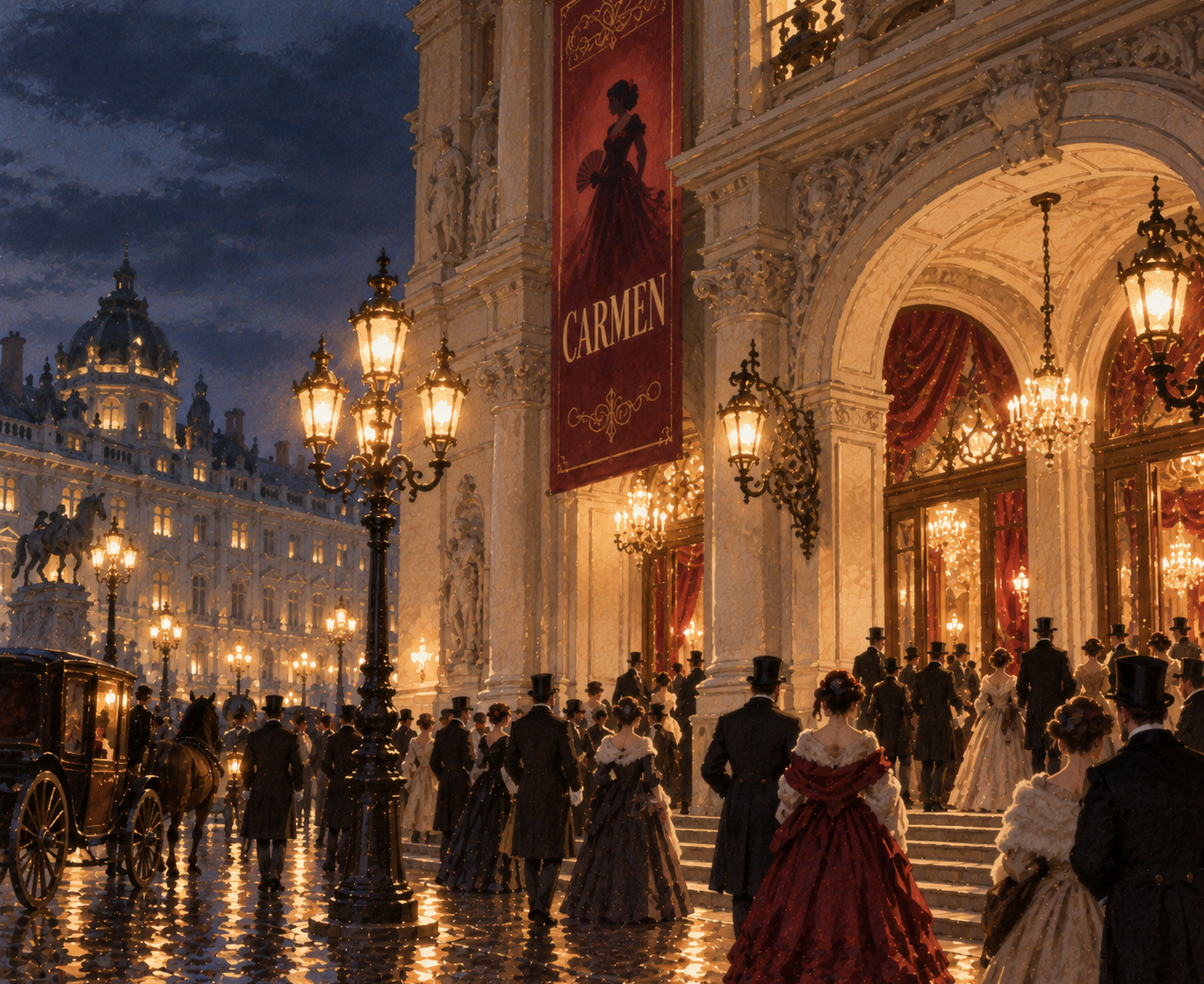
Imagine Paris in the middle of the nineteenth century.
Carriages move through busy streets.
Music drifts from theatres and cafés.
And in a musical family lives a little boy named Georges Bizet.
His father taught singing.
His mother was a talented pianist.
Music was part of everyday life at home.
And Georges had an extraordinary ear.
He could remember complicated music remarkably quickly and showed unusual talent at the piano.
At only nine years old, he entered the Paris Conservatoire.
He was technically too young.
But his talent was difficult to ignore.
Before long, Bizet was winning prizes in piano, organ and composition.
He seemed to be exactly the kind of child everyone expected to become famous.
But being a brilliant student and becoming a successful composer would turn out to be very different things.
The Brilliant Pianist Who Did Not Want to Be a Pianist
Bizet was an exceptional pianist.
The great composer Franz Liszt once heard him perform a notoriously difficult piece and was deeply impressed by his ability.
Bizet could probably have built a successful career as a concert pianist.
But that was not what he wanted.
He wanted to compose.
That choice was much less secure.
A pianist could perform music that audiences already loved.
A young composer had to persuade theatres, publishers and audiences to take a chance on something new.
Bizet chose the more difficult road.
A Young Composer Goes to Rome
In 1857, when Bizet was nineteen, he won one of France’s most prestigious awards for young composers:
the Prix de Rome.
The prize allowed him to live and study in Italy.
Rome was very different from Paris.
Ancient ruins stood beside busy streets.
There were churches, fountains, sunlight and landscapes unlike the city Bizet knew at home.
For a young composer, it was a chance to explore without immediately worrying about Parisian success.
Bizet travelled.
He observed.
He composed.
And he began imagining a life devoted to music.

Paris Was Harder Than Rome
When Bizet returned to Paris, reality arrived quickly.
There were many composers.
There were only so many theatres.
And getting a new opera onto a stage could take years.
Bizet needed money.
So alongside his own composing, he took on practical musical work.
He arranged other composers’ music.
He prepared scores.
He accompanied rehearsals.
He taught.
Hours that could have gone into his own compositions were often spent helping other people’s music reach the page or the stage.
It was not the glamorous life people might imagine for a former Prix de Rome winner.
Bizet had talent.
He had prizes.
What he did not yet have was success.
A Young Man Who Often Doubted Himself
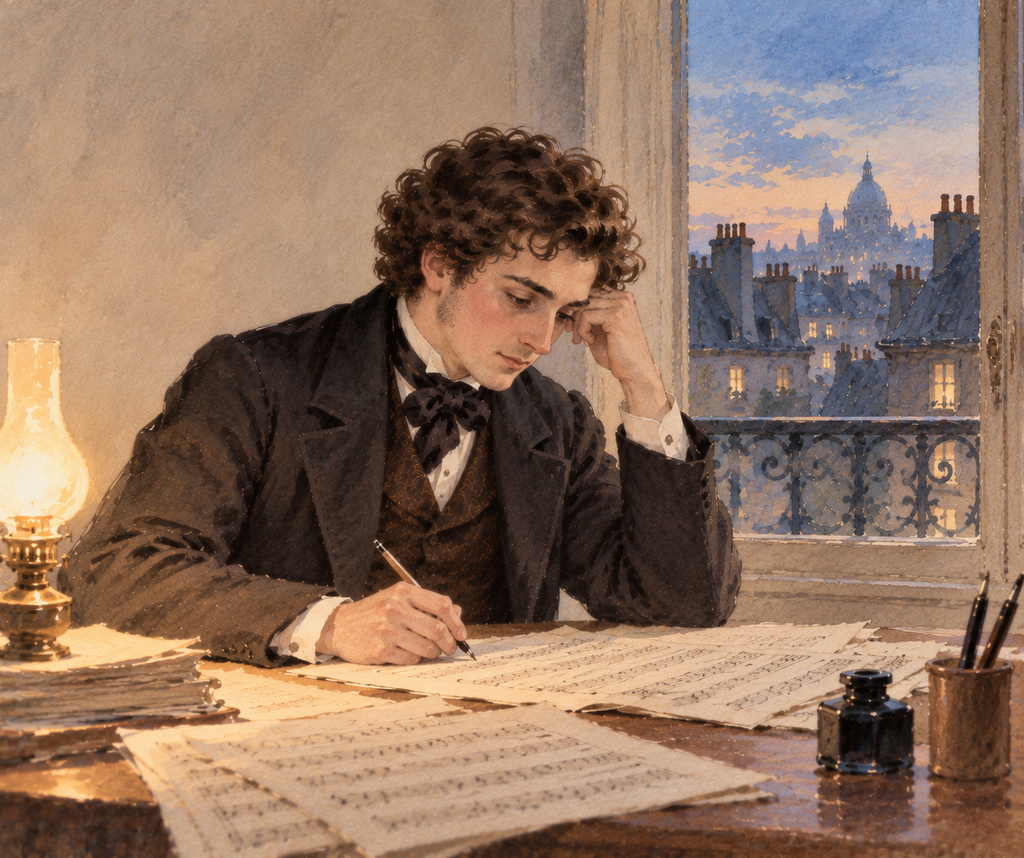
Bizet could be highly critical of his own music.
He started projects and abandoned them.
He revised.
He worried.
Sometimes he seemed confident that he had something important to say.
At other times, he doubted whether his work was good enough.
This makes Bizet rather different from the simple image of the young musical genius.
Talent did not make him fearless.
Success at school had not prepared him for rejection.
He had to keep writing while wondering whether the world actually wanted his music.
The Pearl Fishers
In 1863, Bizet received an important opportunity.
He wrote Les pêcheurs de perles — The Pearl Fishers.
Its setting was Ceylon, today Sri Lanka—a place Bizet himself had never visited.
For the Parisian theatre of his time, distant settings offered composers a chance to create unfamiliar musical colors.
The opera was not a great success.
But one piece survived its disappointing reception.
🎵 Listen for: “Au fond du temple saint” — The Pearl Fishers’ Duet
Two male voices begin separately and then come together in one long melody.
Today it is one of Bizet’s most beloved pieces.
Bizet himself could not have known how long it would survive.
That would happen to him more than once.
War Comes to Paris
Bizet’s life was not happening in a peaceful world.
In 1870, the Franco-Prussian War began.
Paris was besieged.
Food became scarce.
Daily life changed dramatically.
Bizet served in the National Guard.
For a man who had spent much of his life inside conservatories, theatres and rehearsal rooms, the experience brought a very different reality close to him.
Political upheaval continued even after the war.
Paris was changing.
France was changing.
And Bizet was no longer simply the brilliant young student who had once won prizes at the Conservatoire.
He was trying to build an adult life in an uncertain city.

Marriage, Family—and Music
In 1869, Bizet married Geneviève Halévy.
She came from a remarkable musical and intellectual family. Her father, Fromental Halévy, had been Bizet’s teacher and was himself a successful opera composer.
Bizet and Geneviève later had a son, Jacques.
Their marriage was not always easy.
Family tensions, financial worries and Bizet’s own intense working habits could make life difficult.
But behind the name printed on an opera score was a real person trying to balance work, money, family and ambition.
He still wanted the same thing he had wanted as a young man:
to write an opera that truly worked.
What Did Bizet’s Music Sound Like?
Over the years, Bizet developed a remarkable feeling for musical color.
A flute could suddenly make the orchestra feel lighter.
Strings could create nervous energy.
A trumpet could bring an entire crowd to life.
And rhythm mattered enormously.
Bizet’s music could dance.
Tease.
Rush forward.
Suddenly stop.
Then begin again.
He had learned how to make the orchestra feel almost physical.
All he needed was the right story.
Then came Carmen.
The Opera That Changed Everything
In the early 1870s, Bizet was asked to write a new work for the Opéra-Comique in Paris.
The story he and his librettists chose was based on a novella by Prosper Mérimée.
Its heroine was Carmen.
She was independent, unpredictable and unwilling to let another person decide how she should live or whom she should love.
That was already unusual enough.
But Bizet also gave her music unlike the conventional romantic heroine many audiences expected.
🎵 Listen for: “L’amour est un oiseau rebelle” — the Habanera
Carmen describes love as a rebellious bird.
You cannot command it.
You cannot catch it simply because you want it.
The melody circles and sways.
It sounds seductive and playful.
But it also tells us almost everything we need to know about Carmen.
She may love you.
But she will not belong to you.
That was enough.
We don’t need to retell Carmen’s entire story here.
Because what matters in Bizet’s story is what happened when he tried to put this unusual woman on a Parisian stage.
Fighting for Carmen
Creating Carmen was not easy.
The Opéra-Comique traditionally attracted family audiences, and the opera’s story made people at the theatre nervous.
Carmen was not a conventional heroine.
The story involved workers, smugglers, jealousy, violence and death.
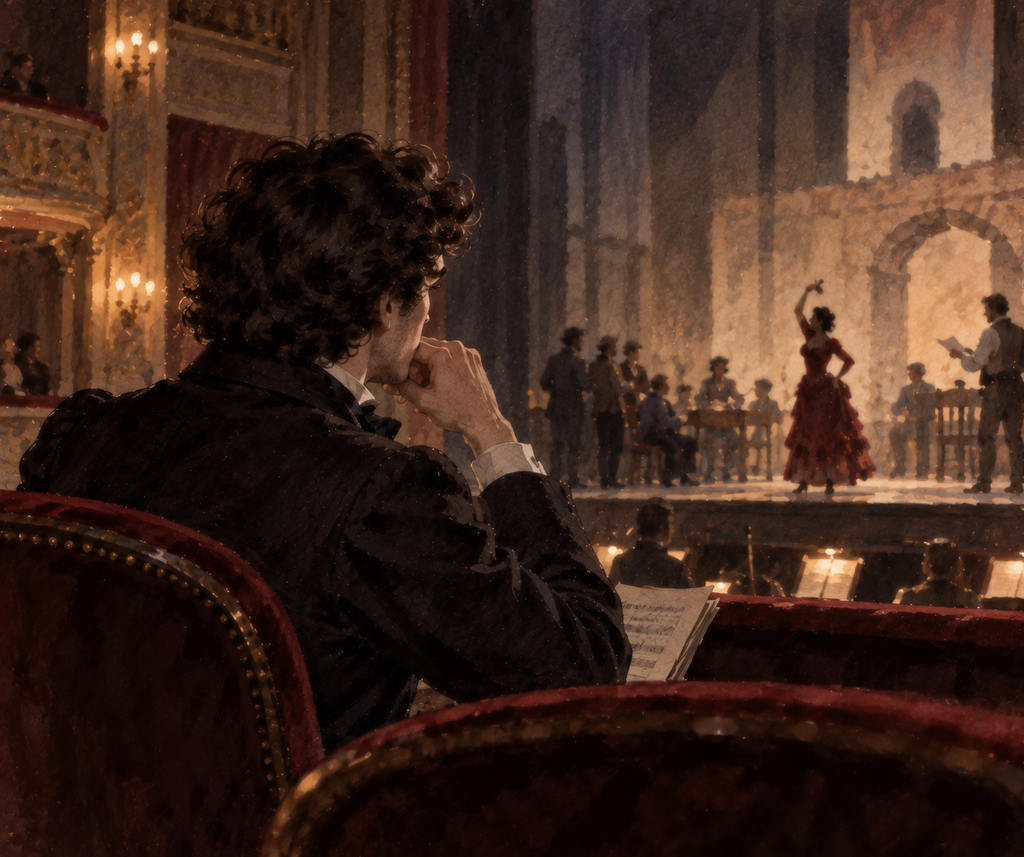
Bizet and his collaborators had to negotiate what could appear on stage.
Rehearsals were demanding.
Bizet continued changing and refining the music.
He was no longer simply the talented student who could write whatever assignment was placed in front of him.
He knew what he wanted the theatre to do.
And he fought for it.
The Night Carmen Finally Appeared
Carmen premiered in Paris on 3 March 1875.
The reaction was complicated.
Some listeners recognized the originality of Bizet’s music.
Others were uncomfortable with the story and its heroine.
Reviews were mixed.
The opera was not the immediate triumph Bizet desperately needed.
Imagine what that must have felt like.
He had spent years struggling.
He had won prizes.
Written operas.
Arranged other people’s music.
Faced rejection and uncertainty.
And now, after all that work, the opera into which he had poured so much of himself still did not seem to have given him the success he had been waiting for.
The Success Bizet Never Saw
Three months after the premiere of Carmen, Bizet died.
It was 3 June 1875.
He was only 36 years old.
He never saw what happened next.
Later that year, Carmen was performed in Vienna.
The reaction was very different.
The opera began travelling.
More theatres performed it.
More audiences heard it.
The Habanera spread.
So did the Toreador Song, the Flower Song, the preludes and dances.
The opera that had made Paris hesitate became an international sensation.
Bizet had spent much of his adult life wondering when real success would arrive.
It arrived just too late for him to see it.
The Strange Story of Success
There is something almost unfair about Bizet’s story.
As a child, he was recognized immediately.
Everyone could see his talent.
He entered the Conservatoire at nine.
He won prizes.
Liszt admired his piano playing.
He won the Prix de Rome.
Everything suggested an easy path toward success.
Instead, adulthood brought years of uncertainty.
And the work that finally made his name immortal became famous only after he was gone.
Today, millions of people know Bizet’s music.
Some recognize the opening of the Habanera after only a few notes.
Many have heard the Toreador Song without ever entering an opera house.
Yet Bizet himself never knew that this would happen.
Why Do We Still Listen to Bizet?
Bizet did not leave behind the enormous catalogue of a Mozart or Verdi.
His life was too short.
But his best music has an extraordinary sense of life.
It moves.
It changes color.
It can sound playful one moment and dangerous the next.
Perhaps that is why Carmen became the character through whom the world finally discovered Bizet.
She refuses to stay still.
So does his music.
As a young man, Bizet had spent years trying to find his own voice.
When he finally found it, the world was not immediately ready.
But the music did not disappear.
Georges Bizet spent much of his life waiting for success.
Then he wrote an opera about a bird that could not be caught.
The bird flew around the world.
Bizet never saw how far it went.