
A Life Full of Music, Mischief, and Imagination
Wolfgang Amadeus Mozart (1756–1791)
Born in Salzburg, Austria
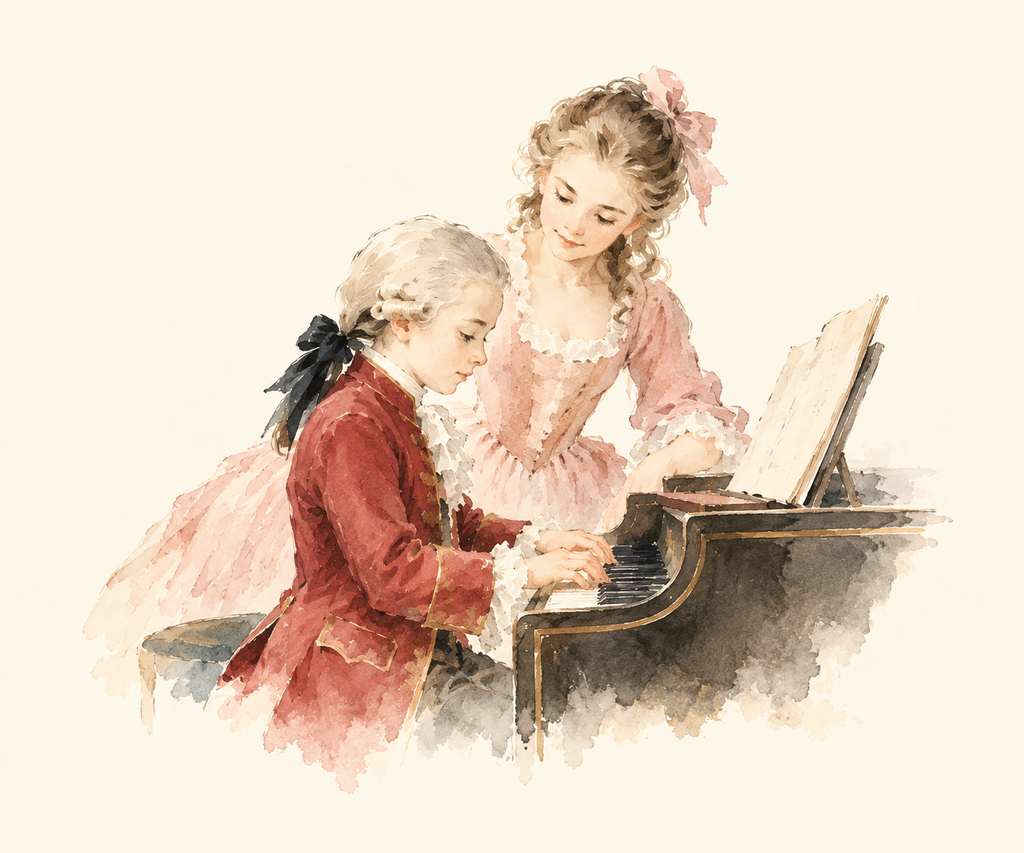
Imagine being three years old and sitting at a keyboard instrument.
Most children might press a few keys just to hear the sounds.
But little Wolfgang Mozart did something different.
He listened.
He noticed which notes sounded beautiful together. He remembered melodies. And before long, he began finding his own music on the keyboard.
His father, Leopold Mozart, was a musician and teacher.
He soon realized that there was something extraordinary about his son.
And Wolfgang was not the only musical child in the family.
His older sister Maria Anna, whom everyone called Nannerl, was also a highly talented musician and an accomplished player of keyboard instruments.
Together, the two children were about to begin a rather unusual childhood.
A Childhood on the Road
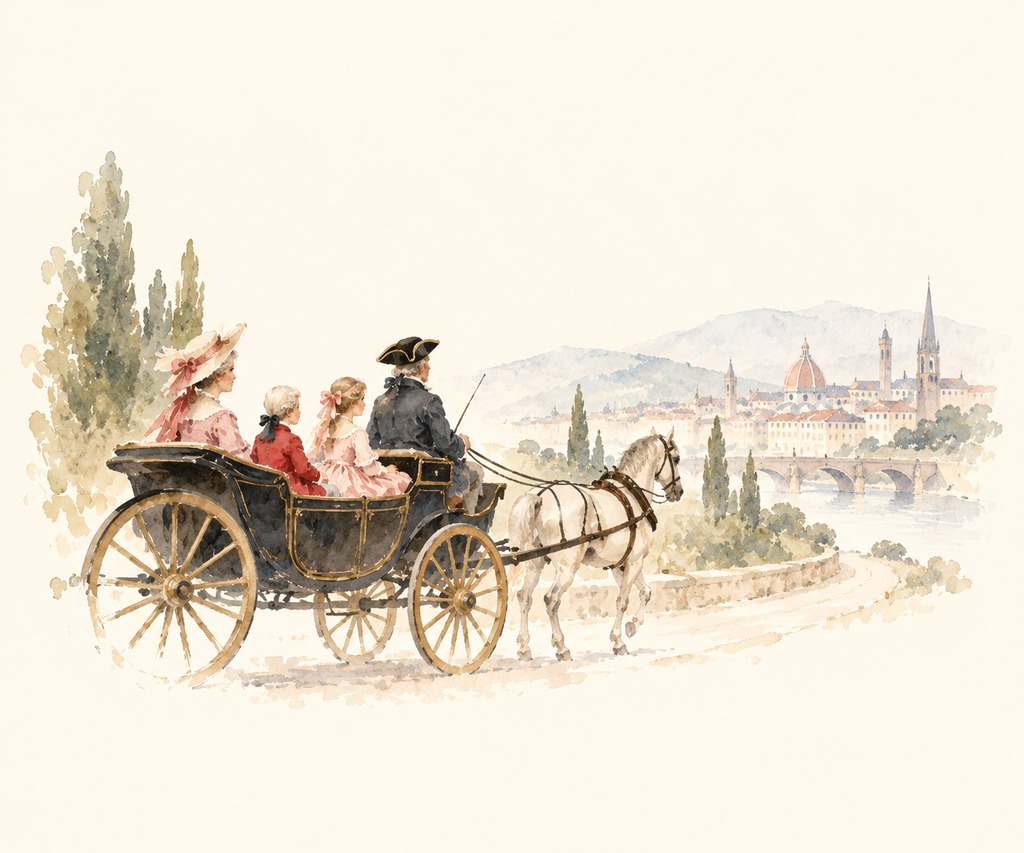
When Mozart was still very young, his father took Wolfgang and Nannerl on long journeys across Europe.
They traveled to places such as Munich, Vienna, Paris, and London.
There were no trains or airplanes.
They traveled for days in horse-drawn carriages, over rough roads and through bad weather.
And when they finally arrived?
They performed.
Kings, queens, princes, and noble families gathered to hear the remarkable children play.
People were amazed by Wolfgang.
He could play music after hearing it only once. He could improvise at the keyboard. He could even play with the keys covered.
But behind the exciting stories of palaces and royal audiences was a lot of hard work.
Travel was tiring.
The children sometimes became ill.
And Wolfgang spent much of his childhood performing instead of simply being a child.
Still, everywhere he went, he listened.
He heard Italian opera, German music, French music, church music, orchestras, singers and instruments of every kind.
All those sounds became part of the music he would later write.
Mozart Grows Up
Being a famous child was one thing.
Becoming an independent adult was much more difficult.
Mozart wanted something that musicians of his time did not always have:
freedom.
He did not want to spend his whole life simply obeying a prince or an archbishop.
He wanted to choose what music to write, where to perform, and how to live.
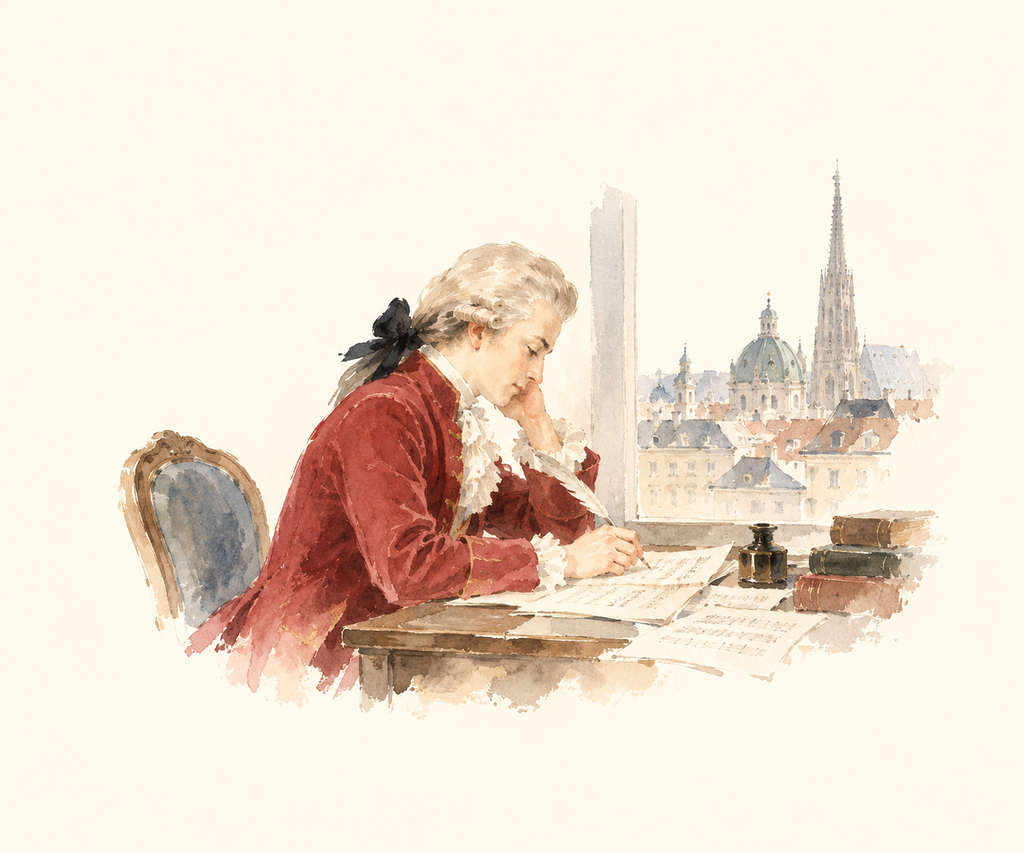
So Mozart eventually left his position in Salzburg and moved to Vienna.
There, he tried to build a life as an independent composer and performer.
It was exciting.
It was also risky.
Some months he earned good money. Other times, things were much more difficult.
But Vienna gave Mozart something he deeply wanted:
the chance to create music in his own way.
Music That Smiles—and Music That Cries
One of the wonderful things about Mozart is that his music can change its mood almost in an instant.
It can be playful.
Then tender.
Then frightening.
Then suddenly make you laugh.
Listen to The Marriage of Figaro, and you hear characters rushing through misunderstandings, jealousy, secrets and love.
Listen to Don Giovanni, and the world becomes darker and more dangerous.
And in The Magic Flute, Mozart gives us comedy, fairy-tale magic, frightening trials, love—and the spectacular Queen of the Night.
🎵 Listen for: “Der Hölle Rache” — The Queen of the Night’s aria
Those impossibly high notes are famous today.
But Mozart was not writing difficult notes simply to show off.
The music tells us who the Queen is at that moment: furious, powerful and almost exploding with rage.
That was one of Mozart’s great gifts.
He could turn a character’s feelings into music.
Mozart the Person
It is easy to imagine Mozart as a serious man sitting quietly at a desk with a feather pen.
He wasn’t always like that.
Mozart loved jokes and wordplay. He could be silly, impatient and mischievous.
He enjoyed parties, billiards and spending time with friends.
But when he worked, he could work with astonishing concentration.
Music seemed to be constantly alive in his imagination.
And he wrote almost everything: operas, symphonies, concertos, chamber music, piano music, church music and much more.
Today, more than 600 works are associated with his catalogue.
That is an extraordinary amount of music for someone whose life was so short.
His Final Year
Mozart died in Vienna in 1791, when he was only 35 years old.
During his final year, he was still composing remarkable music, including The Magic Flute and his unfinished Requiem.
The Requiem has become surrounded by legends and mysterious stories over the years.
But the real story is already moving enough:
Mozart was working on music almost until the end of his life.
He did not live to grow old.
His music did.
Why Do We Still Listen to Mozart?
More than two centuries have passed since Mozart lived.
The palaces have changed.
The carriages are gone.
The world sounds very different.
And yet, when an orchestra begins playing Mozart, something remarkably human is still there.
Joy.
Fear.
Jealousy.
Love.
Loneliness.
Laughter.
Mozart understood that people are rarely only happy or only sad.
We can laugh while we are worried.
We can love someone and still be angry with them.
We can be brave and frightened at the same time.
And perhaps that is why his music still feels alive.
Mozart did not simply write beautiful notes.
He wrote people into music.
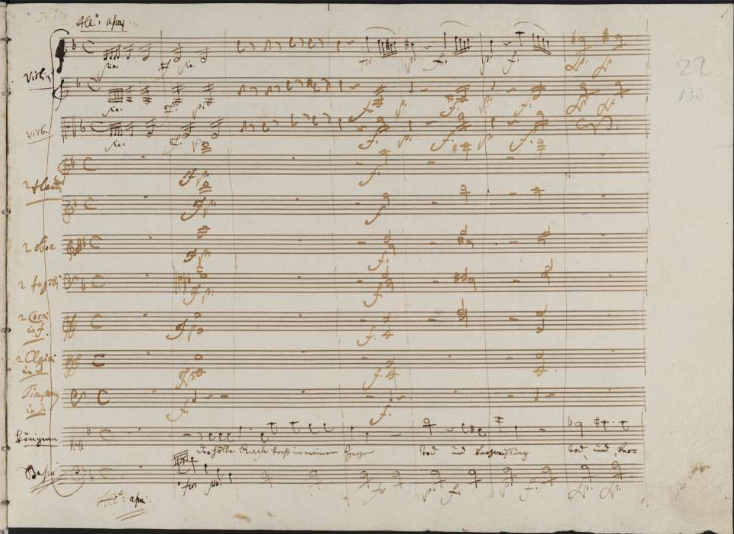
Mozart’s autograph manuscript of Die Zauberflöte, 1791
Stabi Berlin · Permanent link